CoreWeave Leans Into A.I. Software As Infrastructure Costs Soar
- CoreWeave Strategy CoreWeave Leans Into A.I.

Nick Song - CoreWeave Strategy
CoreWeave Leans Into A.I. Software As Infrastructure Costs Soar
In late September, CoreWeave announced a new suite of software products at the company’s “Fully Connected” conference. The event’s main keynote focused on Forge, CoreWeave’s newest software service designed to make it easier to fine-tune A.I. models.
Less than two years after its IPO, CoreWeave wants to pivot away from relying solely on leasing out A.I. infrastructure. Instead, the company envisions itself as also a software provider — offering the platforms that digital developers will use to fine-tune their own A.I. models. The announcement comes a couple of months after CoreWeave launched ARIA — its AI research and coding agent.
“To build a standalone business away from hyperscalers, CoreWeave needs to be a software provider,” said Jay Goldberg, an analyst at Seaport Research Partners. “If it’s just hardware, anyone can do what they’re doing.”
BUT and see my note about bringing up the two paragraphs below
The pivot to software comes as the costs to build out the infrastructure supporting A.I. continue to balloon. Constructing a 1-gigawatt A.I. data center equipped with Nvidia’s latest hardware may cost an estimated $47 billion in capital expenditures. The latest graphics-processing units (GPUs) also require more electricity, driving up operating costs. Treasury bond yields remain elevated and continue to raise borrowing costs for the buildout. The expenses have become overbearing even for hyperscalers with diverse revenue streams like Google and AWS, as they become increasingly dependent on debt to finance expansion.
CoreWeave’s revenue comes almost entirely from leasing its GPUs. As such, a core issue facing neoclouds is that their growth depends on the continued rapid expansion of A.I. data centers. But rising inflation and Treasury yields are raising the cost to construct the needed centers. More importantly, building these data centers has become increasingly unpopular with U.S. voters on both sides of the aisle. The Democrats' sweeping midterm-election victory has cast more doubt on how easy it will be to build enough new data centers for neoclouds to outpace their debt.
“Sometimes there’s a question of whether a business should exist,” said Gil B. Luriam, the head of technology research at D.A. Davidson. “CoreWeave is one of those examples.”
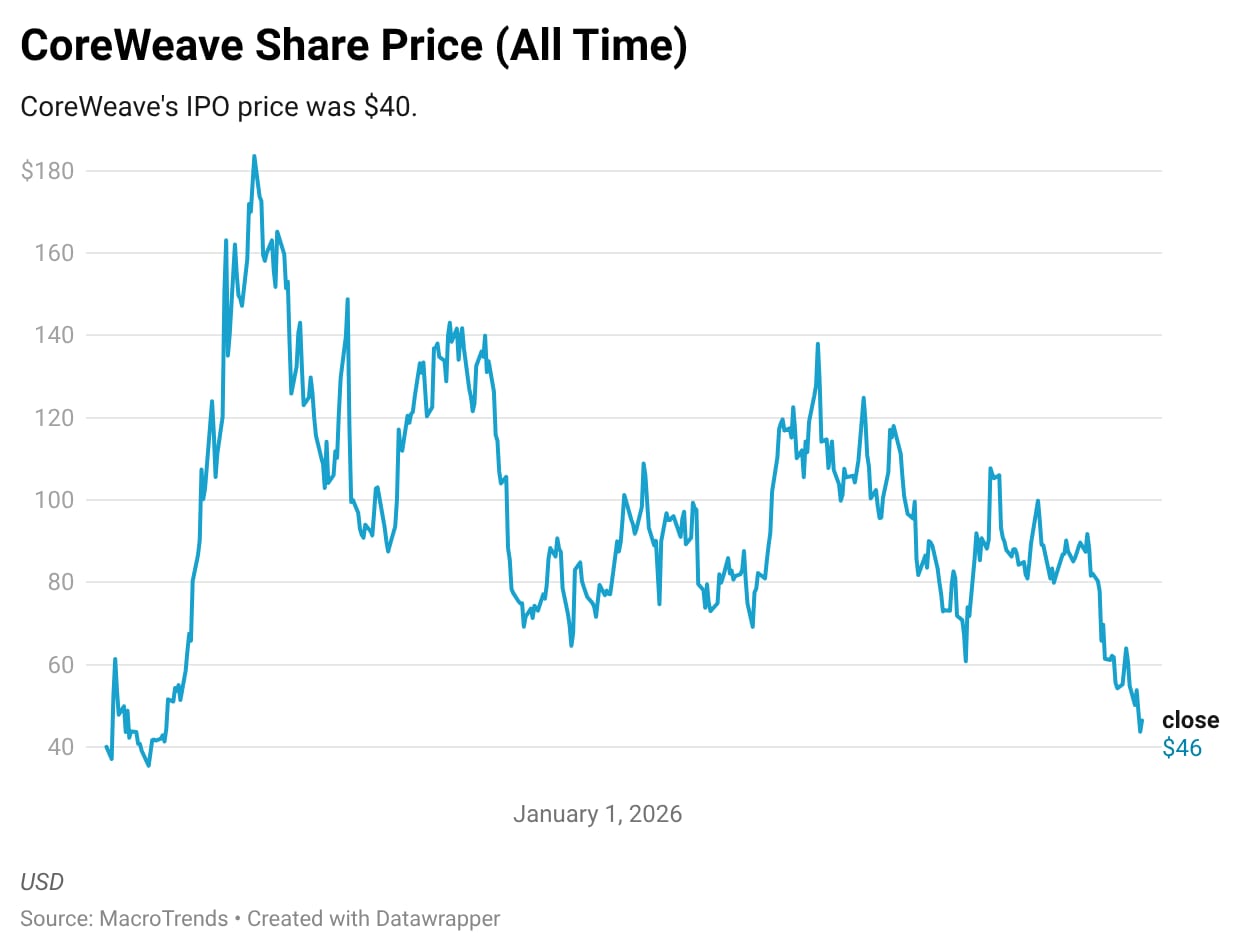
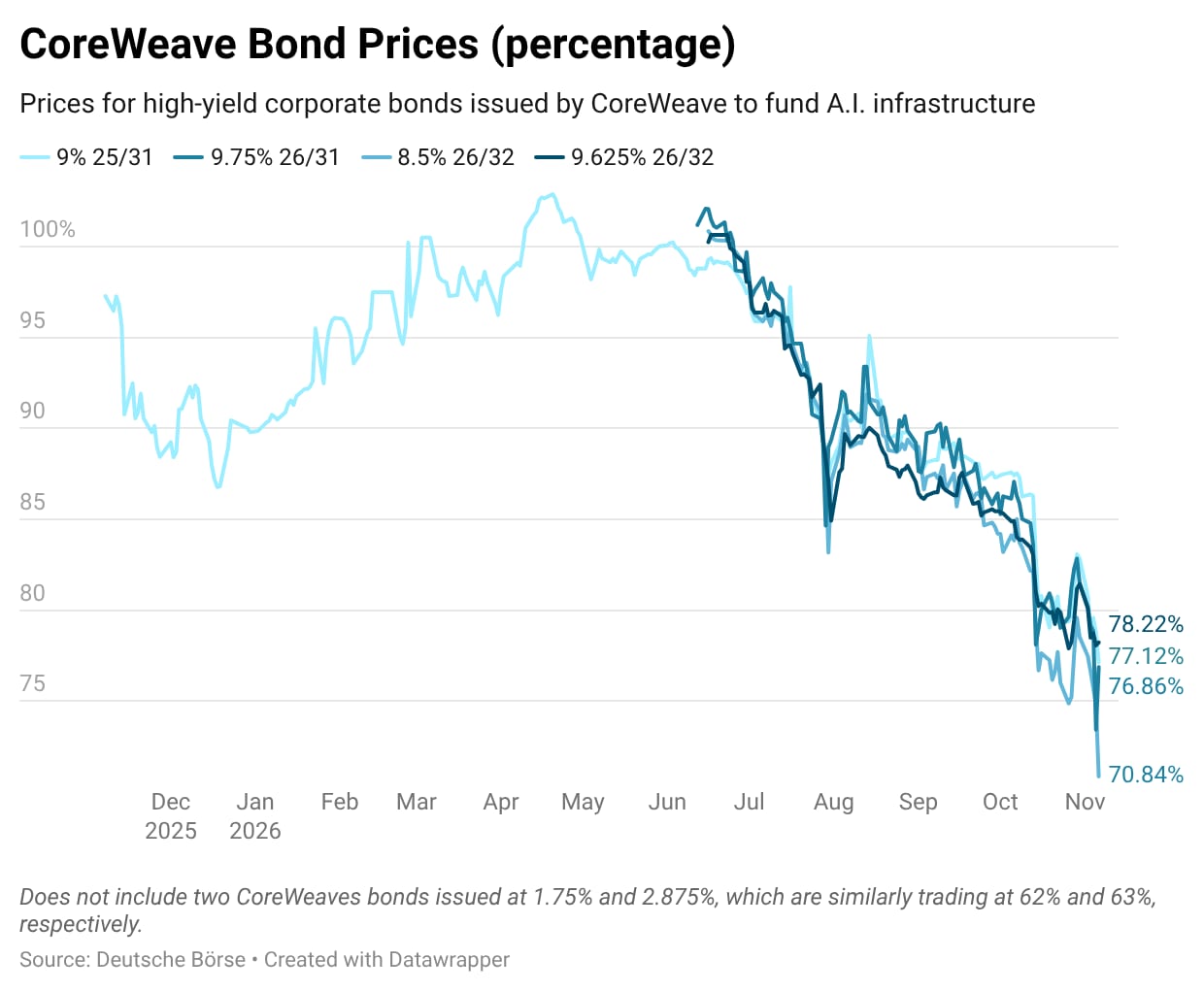
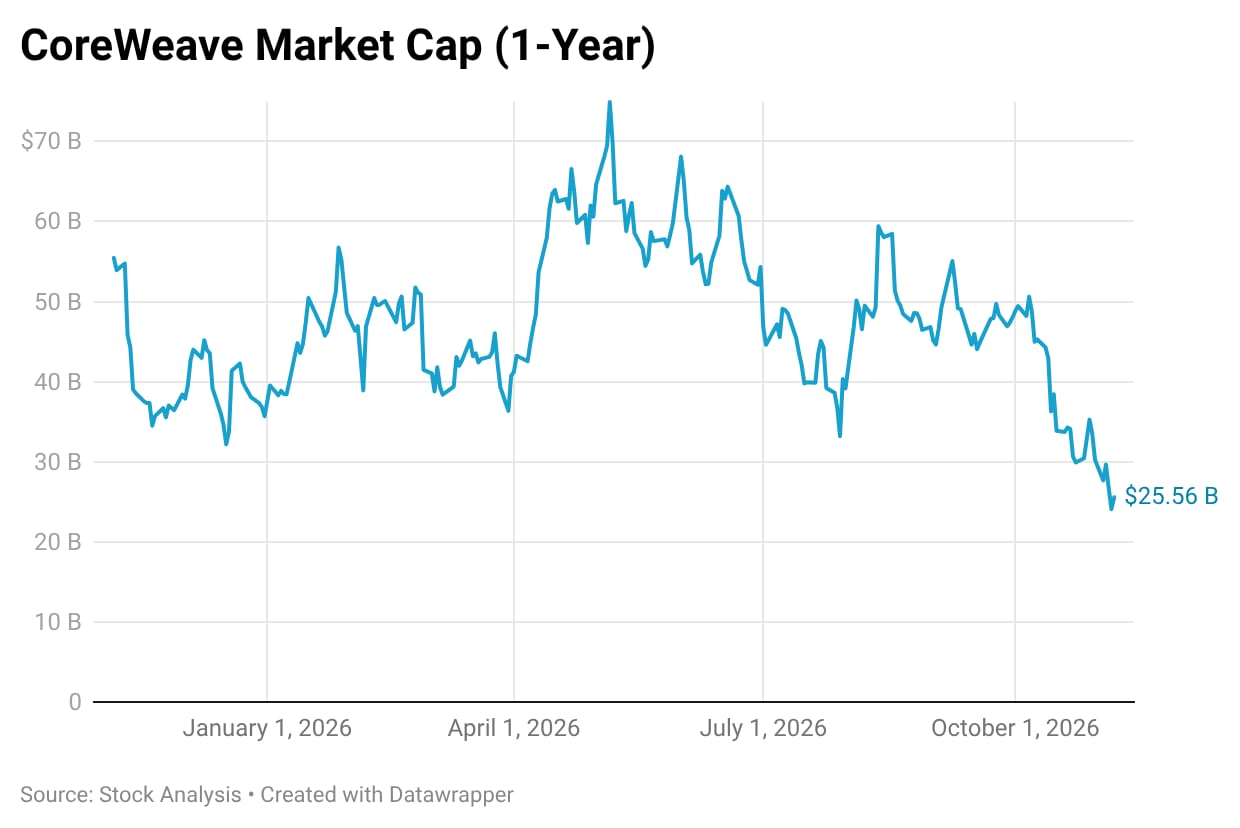
With these various factors, investors have become skeptical of CoreWeave’s neocloud business model. A recent Gartner report estimated that over 80% of neoclouds will fail by 2030 due to cost pressure and “a lack of a differentiating business model.” That skepticism spilled into the secondary markets. Since hitting its yearly high of $138 in May, CoreWeave’s share price has fallen by almost two-thirds — just dollars above its initial IPO price.
Originally a bitcoin-mining operation, CoreWeave pivoted to leasing hardware after the 2018 cryptocurrency crash. The company began leasing its GPUs to Microsoft, Meta, and other “hyperscaler” cloud service providers. The new playbook paid off as demand for A.I. infrastructure exploded. CoreWeave’s success as a “neocloud” has spawned similar businesses looking to get in on the action.
CoreWeave’s expansion into software has been in the making for the past couple of years. CoreWeave first launched its Mission Control software, which lets developers manage workloads on CoreWeave’s hardware. Last year, the company hired Jon Jones as its Chief Revenue Officer. Jones had previously worked at AWS, where he oversaw the company’s global startups and venture capital businesses.
“The scale of AI adoption demands entirely new products and services," said Michael Intrator, co-founder and CEO of CoreWeave, in the press release announcing Jones’s hiring.
It has acquired a slew of startups, many of which it folded into Forge. The company purchased Weights & Biases for $1 billion last May, an A.I. development platform that lets developers test open-weight models and run machine learning experiments. CoreWeave spent another $348 billion in additional acquisitions that year, which company leadership said would “expand the Company’s vertically integrated, full-stack platform,” according to SEC filings.
Forging Ahead
Forge looks to capitalize on the increased popularity of open-weight A.I. models like DeepSeek and Qwen, which differ from closed models like ChatGPT and Claude, whose creators prevent developers from going under the hood to alter the model.
Open-weight models can be downloaded online, run on local computers, and be freely tinkered with. Though typically less powerful than closed models, developers can fine-tune an open-weight model to better accomplish a niche task.
If A.I. developers were car mechanics, CoreWeave designed Forge as a garage: a way for developers to easily fine-tune their engines and test out their modifications. The company’s leaders want Forge to be an all-in-one environment where developers can continuously test their applications to make more accurate predictions. The service also integrates CoreWeave’s GPU infrastructure, helping developers deploy their models easily.
Keith Townsend is an example of a developer CoreWeave hopes to court with Forge. As the founder of The CTO Advisor, Townsend works with enterprises and consults on A.I. and infrastructure. Soon after Forge launched, he decided to test Forge’s ability to fine-tune and run models. He tested Forge’s iteration ability by running the same processing task on both Forge and his home setup — which consists of $26,000 worth of computers designed specifically for A.I. His home system took 2-4 hours to complete the experiment; Forge did it in just half an hour.
“That is the argument for Forge: simplify the process,” said Townsend. “Bring your data — you don’t have to worry about GPUs and all of that. It is almost a SaaS-like service for training and fine-tuning your open-weight model.”
Forge’s openness may also draw developers to the platform. Other services for fine-tuning models typically lock developers to the service — meaning developers cannot easily export their tuned model and deploy it on another cloud provider.
Dubbed “hyperscaler lock-in,” CoreWeave hopes to differentiate itself by allowing developers to deploy models trained on Forge on any chosen infrastructure — whether that be using a hyperscaler cloud service or on a local setup like Townsend’s.
“One thing that we've been very intentional about is leveraging open source tools and technologies contributing back to open systems so customers have flexibility,” said Urvashi Chowdhary, VP of Product Management at CoreWeave, in an interview at the company’s Connected conference.
The Problem With Neoclouds
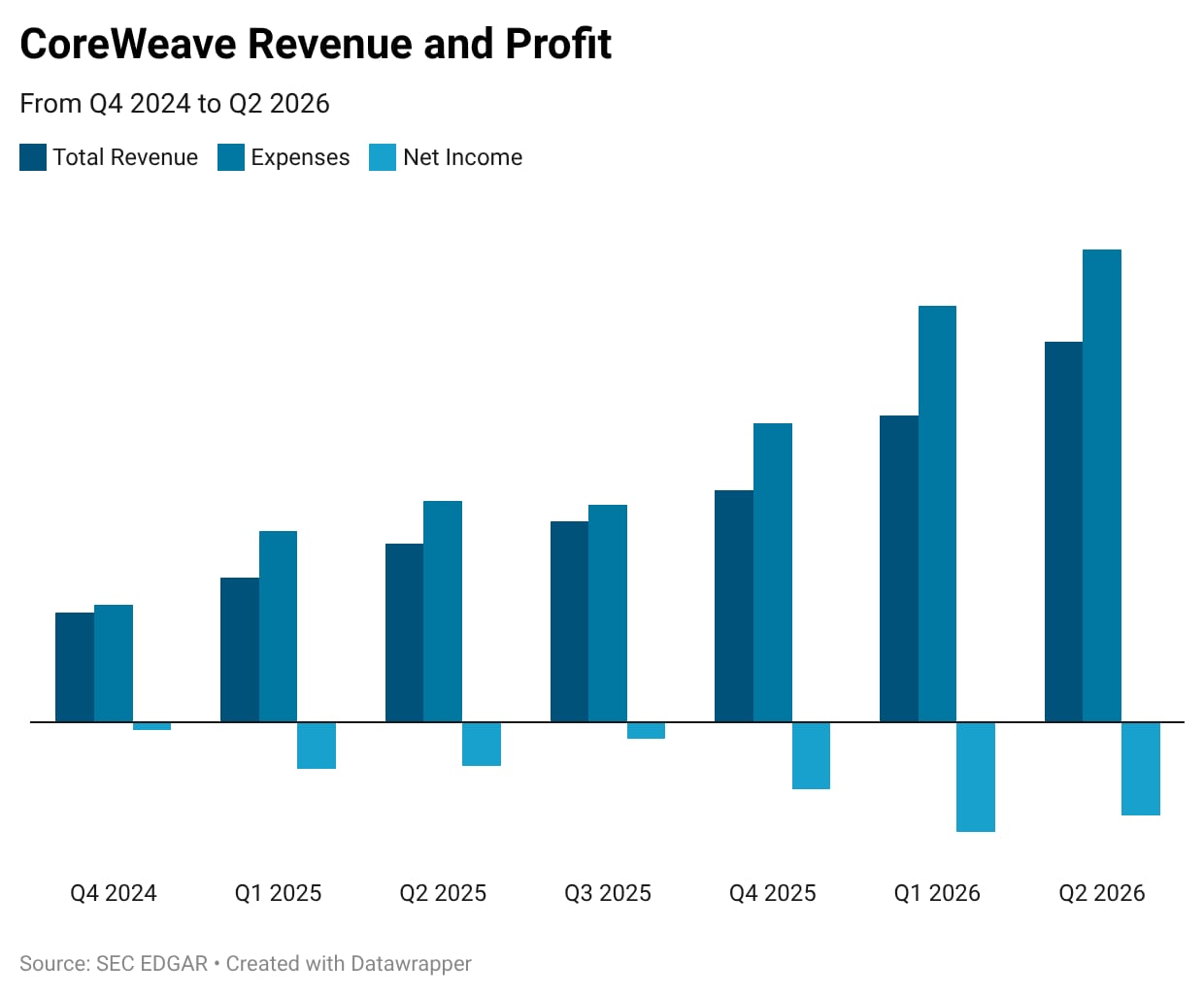
CoreWeave has benefited tremendously from the current compute gold rush. Its annual revenue has increased 167 percent to $5.1 billion. Analysts project the company to generate $12.9 billion in annual revenue for 2026 and $26.9 billion for 2027. But those projections rest on several assumptions: that demand for compute will remain high and that companies will continue building new data centers for neoclouds to house their growing GPU arsenal.
And profits?
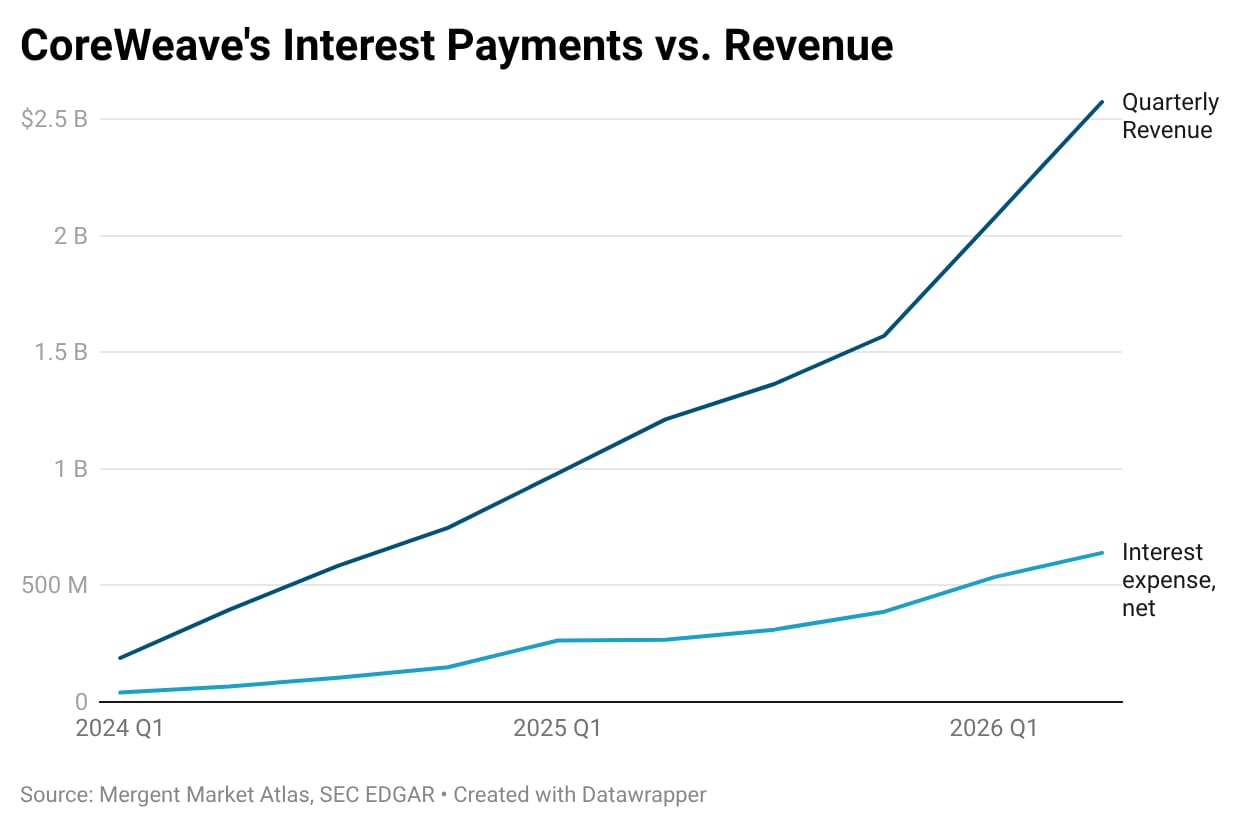
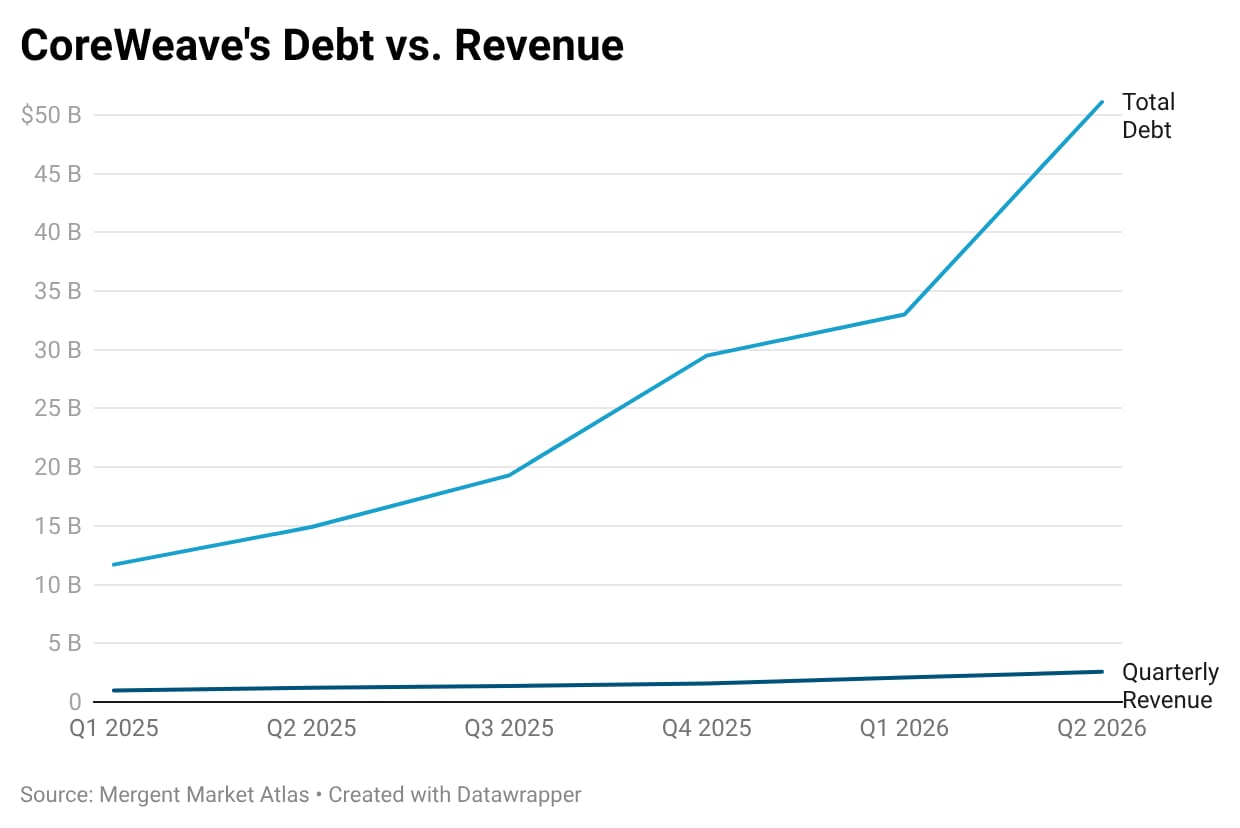
The company has bet that its revenue growth will far outpace its rapid debt accumulation. While revenue has increased dramatically, so too has the debt it’s taken on to pay for new computer chips.
The company has issued billions of dollars in corporate bonds backed by its backlog in GPU lease contracts. In June, CoreWeave paid $640 million in interest on its loans, roughly a quarter of its overall revenue for that period.
CoreWeave’s growing focus on software comes as tech companies shift away from training models. The industry has increasingly focused on A.I. “inference” — the deployment and subsequent optimization of A.I. applications. A recent McKinsey report projects inference to account for 60 percent of all A.I. workloads. CoreWeave views inference as an area to provide support.
“The last five years have all been about training models — about ‘building the brain,’ ” said Arvind Ramnani, a senior analyst at Truist Financial. “The next three-to-four years will be about using the brain.”
Whether the effort will pay off will take more time.
“I think they’re taking solid steps to develop, but there’s still a long way to go,” said Luke Yang of Morningstar. “Compared to the software developed by hyperscalers, CoreWeave is still on a much smaller scale.”