Run It Back: How Nike Is Putting Athletes First Again
Down 20 points in the fourth quarter against No.1 Ohio State, the Texas Longhorns looked out of answers.
Down 20 points in the fourth quarter against No.1 Ohio State, the Texas Longhorns looked out of answers. What more than 100,000 fans packed into Darrell K Royal–Texas Memorial Stadium witnessed next was a stunner for college football.
The home team executed three consecutive 12-plus-play drives, capped by Hollywood Smothers leaping over a wall of defenders with just 25 seconds left, to pull off a 24-23 victory.
Feeling the stadium shake firsthand on that sweltering September night was Daniel-Yaw Miller, founder of SportsVerse, a newsletter covering the intersection of sports and culture.
“It was without a doubt the most electrifying live sports moment I've experienced since moving to the States a couple of years ago,” says the Englishman.
When the final whistle blew, the Longhorns’ unthinkable late-game charge may not have been the only comeback sealed that night.
UT CAMPUS TAKEOVER
In the week leading up to the biggest game of the early college football season, the University of Texas campus belonged to a sportswear giant in the middle of a major turnaround.
Nike continues to navigate a years-long slump that has wiped out over $200 billion in market value since late 2021. Its root cause lay in an identity shift: under former CEO John Donahoe, Nike was leaning too heavily on legacy lifestyle franchises like the Dunk and Air Force 1. Elliott Hill, who took over in October 2024, is trying to bring the brand back to its athletic roots.
“Sport Offense” is Elliott Hill's push to realign the company around athletes, individual sports and performance innovation. The initiative sits at the heart of Hill’s broader “Win Now” turnaround strategy, whose objectives also include clearing excess inventory and repairing wholesale retail relationships.
Pulling back from traditional retail partners such as Foot Locker and Dick’s was another reason for Nike losing market share to rivals like On and Hoka. Between 2016 and 2025, Nike's share of the US sports footwear market dropped from 40 to 30%, according to Euromonitor.
“Sports is where Nike has a big advantage, because they have the most sponsorships, athletes, leagues,” says David Swartz, a senior equity analyst at Morningstar. “So the ‘Sport Offense’ strategy makes all the sense.“
That week in September, Nike invited UT students to a morning run along Lady Bird Lake with Nike Running that also included free breakfast and t-shirt giveaways; a night workout at the Longhorns’ football weight room with Nike Training and a yoga session with NikeSKIMS, which also offered students discounts at its pop-up store.
UT legend Kevin Durant returned to Austin to welcome four new members to Team KD, his Nike partnership that sponsors and mentors Texas basketball student-athletes. Meanwhile, 13 more Longhorns across eight sports joined the Blue Ribbon Elite program, where Nike partners with universities to sign whole cohorts of elite athletes as brand representatives. Its roster now features five Texas football players, including Ryan Wingo, whose touchdown ignited a historic fourth-quarter comeback (notably missing is Arch Manning, a brand ambassador for Nike competitor Vuori).
“This was Nike surrounding a moment, deploying our full ‘Sport Offense,’” Nike Chief Executive Officer Elliott Hill said in October on the company’s fiscal first-quarter earnings call with analysts. “Something no one else can do. It was the kind of focus on the ground game that helps us become more locally relevant.”
BETTING ON ATHLETES
Having spent the week in Austin, Miller sees the UT campus programming as the blueprint for Nike’s future.
“This is how Nike is trying to win back young consumers, a demographic where they used to be a no-brainer choice, but aren't anymore,” he says. “These activations are designed to drive ‘brand heat’ and customer loyalty.”
At the same time, the Blue Ribbon Elite program — rapidly expanding since its December launch and now including over 100 collegiate stars nationwide — serves as the latest reminder that athlete endorsements remain the cornerstone of Nike’s identity.
The company’s more-than-40-year partnership with basketball legend Michael Jordan stands out as a textbook example of a successful athlete deal. In fiscal 2026, Jordan Brand shoes and apparel generated $7 billion in sales, or roughly 15% of Nike’s $46.4 billion total revenue.
Through Blue Ribbon Elite Nike recruited Louisiana State University basketball star MiLaysia Fulwiley and football standouts Colin Simmons (UT) and Jordan Seaton (LSU). The company, in turn, is positioning itself for future professional partnerships, notes Katherine Rowe, founder of advisory firm The Playbook and a UT alumna, while at the same time “giving students and fans more reasons to engage with the brand today.”
“The ‘Sport Offense’ is driving results. As Elliott Hill previously said, we have learned through the ‘Sport Offense’ that focus wins. When teams get closer to the athlete, the consumer and the marketplace, they make better decisions,” Nike said to The Times Square Investment Journal in an emailed statement.
Currently, Nike’s massive roster of elite athletes features LeBron James and Durant in basketball; Cristiano Ronaldo and Erling Haaland in soccer; Rory McIlroy in golf and Aryna Sabalenka in tennis.
The lineup suffered a setback in September, when French soccer superstar Kylian Mbappé opted not to extend his contract with Nike and left for On. Given that Ronaldo, James and Durant are all retiring soon, does Mbappé’s exit spell trouble for Nike?
Sydney Goodman, analyst at Bloomberg Intelligence, doesn’t think so. “All three hold lifetime deals with Nike, so their signature shoes will continue to be sold,” she says. “Nike also has tons of younger athletes, including Caitlin Clark and many men's basketball players.”
A standout guard for the Women’s National Basketball Association’s Indiana Fever, Clark has become the face of Nike’s bet on women's sports. Her Caitlin 1 signature shoe nearly sold out less than two hours after its release in October. The W’s next superstar, JuJu Watkins from University of Southern California, earlier this year became the first athlete to co-create a design for the Nike LeBron shoes series.
Beyond names, Nike also has teams. Lots of them.
On that historic September night in Austin, both Texas and Ohio State wore the Nike Swoosh logo, a sight that is hardly unique. With the addition of the University of Miami, Nike now equips 48 of the 68 elite college sports programs, notes Rowe.
That dominance extends to major American pro leagues, where Nike exclusively provides apparel for the National Football League (through 2038), the National Basketball Association (2037) and Major League Baseball (2029).
INNOVATING THE PRODUCT
Sponsorship contracts are an important part of the Sport Offense strategy, but securing leagues and athletes may not be enough for Hill, now in his third year at the helm, to win back Wall Street’s enthusiasm.
Following weaker-than-expected earnings and a disappointing outlook for the year, Nike’s stock plunged below $32 for the first time since September 2013. The shares have since rebounded, closing at $38 on Nov. 13. Still, down 41% for the year, the stock is hovering near its worst year on record.
Focus on performance innovation is another pillar of Sport Offense. Hill merged the design, product and innovation teams across all Nike’s brands into a single athletes-focused department.
Nike’s running division delivered the first measurable results from this shift, posting double-digit growth and sixth consecutive quarter of gains even as overall revenue fell 5% to $45.9 billion. The sportswear giant’s leadership attributed the progress to strong sales of the Vomero shoe line, which is endorsed by legendary runners like Faith Kipyegon and Sha'Carri Richardson and emphasizes extra cushioning for runners’ feet.
“The combination of ZoomX and ReactX foams makes Vomero 18 feel really enjoyable on long runs,” says running coach Amanda Brooks. “The softness doesn’t leave, but you never feel like the shoe is sucking away your energy.”
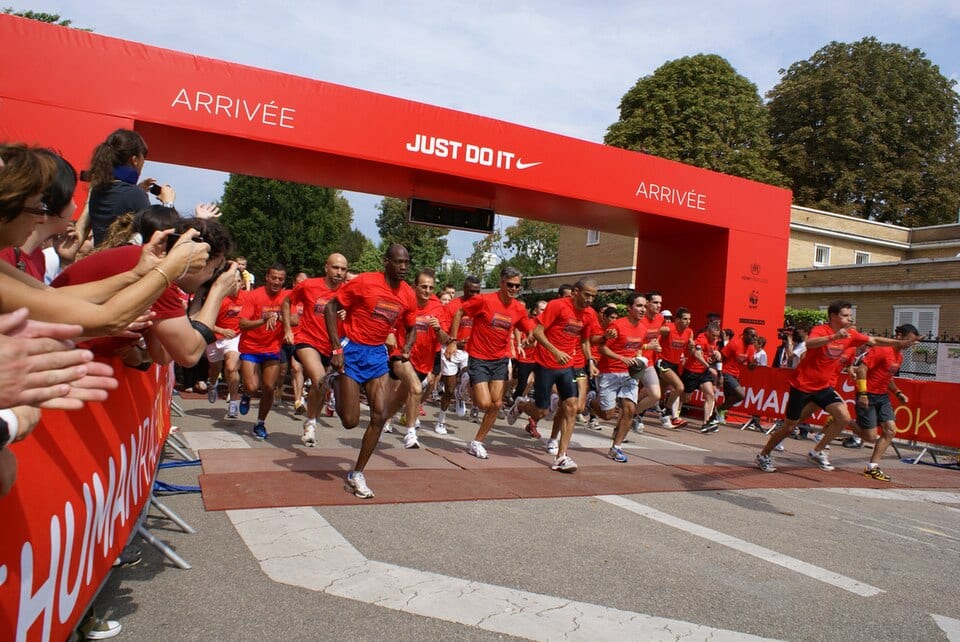
Nike drops its next running shoe for marathoners in January. But the Apex model is already making headlines. On Nov. 1, Swede Andreas Almgren won the New York City Marathon, wearing a pair of Apex.
This category rebound, however, closely mirrors broader US footwear sales as running outpaced all other sports categories in the first half of the year, growing 13% in both dollars and units, according to data provider Circana.
And the latest results of Nike’s competitors tell a similar story: running-focused brands On and Hoka reported 17% and 8% sales growth respectively in their latest quarters, while brands like Lululemon, Under Armour and Puma have all been in the red alongside Nike’s overall business.
“Overall, Nike is still losing share and underperforming the market,” says Neil Saunders, managing director of GlobalData. “This is a consequence of the company’s stumbles, but it also reflects the fact that Nike is still the market leader, which makes it a natural target for all the brands that are expanding.”
Swartz identifies On as a particular threat for Nike. “Today, On is still more than 90% footwear,” he says. “But their apparel business is growing. They’re already having success in tennis. They’re launching football with the help of Thierry Henry and Kylian Mbappé. So there will be more competition for Nike.”
Analysts estimate Nike revenue will decrease to $42.9 billion in the fiscal year ending May 2027, down nearly 8% from the prior year. Morningstar's Swartz expects the company to make $1.7 billion in profit, a 45% annual drop.
For Hill, growth in running might be the first touchdown but completing a turnaround will require more time and progress. The executive sees that September game in Austin as the prototype for the company.
“What stood out to me about Texas' comeback win was how they got there,” Hill said on the call with analysts in October. “A series of methodical drives, a few calculated risks, extra effort in critical moments. They stayed committed to the plan and eventually the scoreboard caught up.”
Analysts remain skeptical.
On a scale from 1 to 5, in which 5 is a buy and a 1 is a sell, Nike’s stock now has a consensus analyst recommendation of 3, its lowest on record, according to Bloomberg.