The New York Times Readjusts Advertising Revenue For Upcoming Quarter
The New York Times Readjusts Advertising Revenue For Upcoming Quarter New York Times shares soared after the news giant reported third quarter earnings that beat Wall Street expectations, with double digit gains in subscriptions and advertising revenue.

The New York Times Readjusts Advertising Revenue For Upcoming Quarter
New York Times shares soared after the news giant reported third quarter earnings that beat Wall Street expectations, with double digit gains in subscriptions and advertising revenue.
The media company posted net income of $97.4 million in the third quarter, or 68 cents a share, up from $81.65 million a year earlier. Revenue rose 9.7% to $768.5 million. Both exceeded analyst expectations of 64 cents a share and revenue of $767.2 million, lifting shares 3.92% to $69.75 in premarket trading following the earnings release.
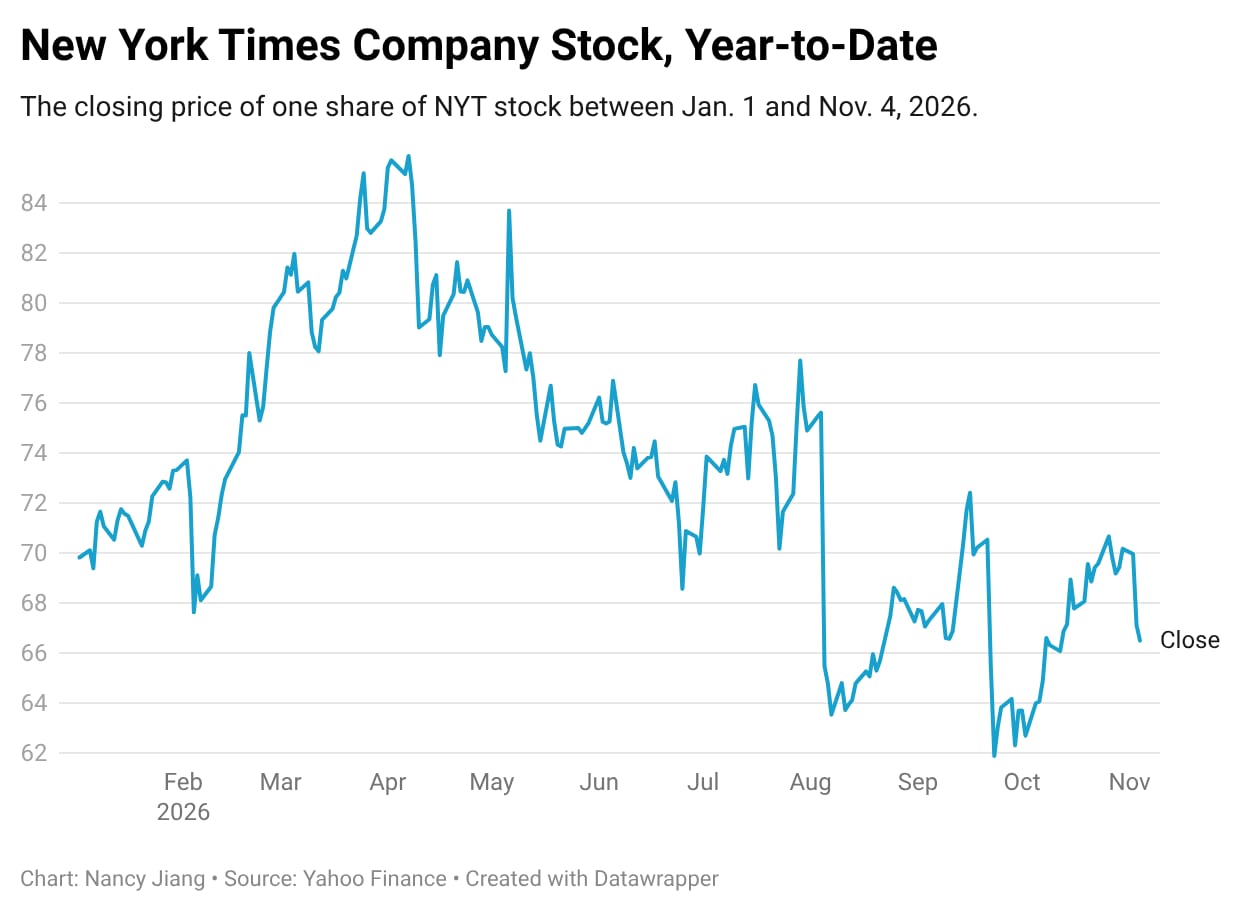
“It was a strong quarter, it wasn’t a great quarter,” said Doug Arthur, an analyst at Huber Research Partners.
The Times reaffirmed guidance that its fourth-quarter total subscription revenue would rise 9% to 11% and digital-only subscription revenue 12% to 15%. The company lowered its projected advertising revenues, down from low double digits the quarter prior to single digits in the fourth quarter, signaling strong subscription growth and resilience that detracts from advertising dependency.
The upcoming quarter is expected to be the Times’ largest for advertising, with digital advertising growing 25% the year prior, but even more ads may not prove to be a juice worth squeezing.
“Exactly where ads are going to land in the quarter could be hard to predict,” said Meredith Kopit Levien, The Times’ chief executive officer, on the earnings call. “The comps get tougher as the year goes on.”
The company is turning its focus to subscriptions, including its bundle, which pairs news with sports coverage from The Athletic, podcasts, Cooking and Games, gains steam. Subscription revenue reached $547 million in the third quarter, up 10.7% from the year before. Digital-only subscriptions, up 14.6%, supplied more than three-fourths of total subscription revenue, while print, down 0.7%, supplied the rest.
The Times increased readership at a faster clip with a quarterly increase of 420,000 subscribers for a total of 13.76 million subscribers, up 11.6% from the previous year. More people are turning to the outlet for news in the age of AI-generated information, the company said, especially during midterm elections, which have historically brought in subscriptions and readership.
In midterm years 2018 and 2022, net digital subscription additions accelerated in the third quarter and peaked in the fourth quarter, which includes Election Day. To drive reader engagement, the company launched a dedicated midterm elections hub within its flagship app including live data visualizations, polling, and campaign spending analysis.
“The elections clearly, I think that will continue to boost [subscriptions] up,” said Arthur. “I don't care what site you're on, you can't tell if information is fake or not and it gets to a point where you just don't want to even look at anything.”
The outlet is on track to a 15 million subscriber goal by the end of 2027, with the fastest rate in 2026 after its slowest subscriber rate in a year the quarter prior, which saw just 280,000 digital-only subscribers. The company’s digital-only average revenue per user has grown slightly, up 1.4% from the previous year to $9.93, signalling reader loyalty in the face of rising costs.
“Growth was supported by subscribers moving from promotional rates to higher prices, as well as from ongoing price increase programs,” said William Bardeen, The Times’ chief financial officer said in an earnings call.
The outlet’s subscription cost remains a lever the company can pull to boost revenue, though with care so as to not spark a mass exodus, analysts said.
“As certain longtime subscribers come up for renewal, they'll price increase that,” said Arthur. “But it's gradual — they don't want to lose subscribers because of price.”
Some individual investors, like Ohio State University student Liam McCarty, are betting on the Times’ 175-year journalism track record as generative AI makes vetted information more coveted.
“People will return and appreciate those things they used to. The reality is that there are still good, hardworking Americans out there that believe in democracy,” McCarty said.