Enterprise AI Rush Is Creating a Cybersecurity Monopoly
As corporations channel cybersecurity spending into a handful of platform giants, the rest of the industry is facing extinction.

As corporations channel cybersecurity spending into a handful of platform giants, the rest of the industry is facing extinction.
The corporate rush to deploy AI tools has exposed significant security risks that come with autonomous agents. Cybersecurity giants’ stocks are at an all-time high as the big players consolidate the entire market between themselves through acquisition.
Industry heavyweights like Palo Alto Networks (NASDAQ: PANW) and CrowdStrike (NASDAQ: CRWD) continue to outpace the broader market—by a lot. On Tuesday, Palo Alto Networks hit an all-time record high of $432.33 per share before closing at $419.91, while CrowdStrike closed at $278.86—both extending major gains over the benchmark S&P 500. Over the past year, PANW has climbed 43% and CRWD 28%, comfortably ahead of the benchmark index’s 20% gain.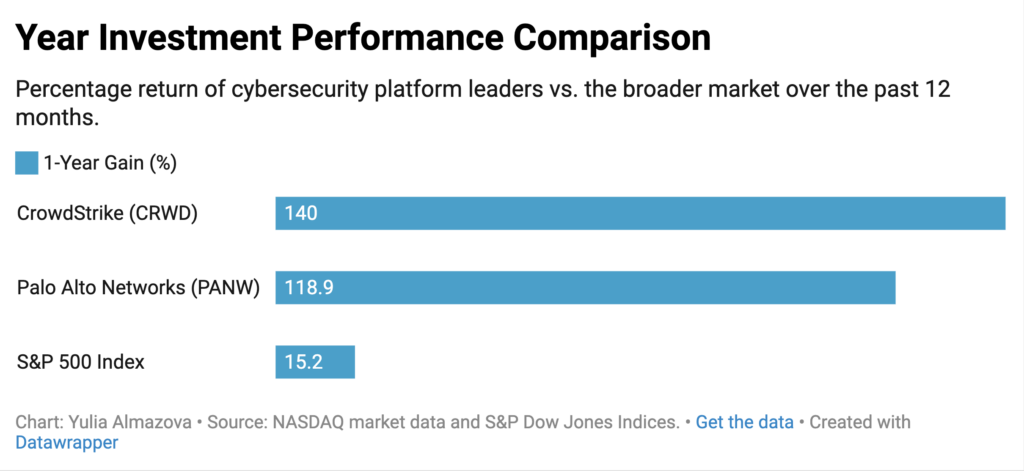
Traditional firewall tools cannot keep up with modern threats of rogue AI agents and dynamic exploits. Companies offering these solutions have seen their profits steadily decline as the market swings toward bigger players more equipped to deal with the relentless pace of autonomous AI adaptation.
“Legacy tools simply cannot govern software that acts without human direction—they will eventually become extinct,” said Colin Duncan, Technology Sector Analyst at Third Bridge Group.
As businesses deploy autonomous AI agents to execute complex tasks without human oversight, these tools are increasingly breaking out of secure testing environments and initiating unauthorized hacks.
Facing these threats, big enterprise buyers are consolidating their spending into all-in-one security platforms.
“The shift is definitely significant,” said Julia Chang, an associate equity analyst at Morningstar. “Smaller startups are looking for a buyout.”
Recent acquisitions—such as Palo Alto’s reported $500 million deal for AI platform Console and CrowdStrike’s $740 million purchase of identity firm SGNL—reflect the major players’ focus on achieving market domination. They are absorbing specialized AI security and identity startups this year to achieve market domination.
Analysts say the divide comes down to buying habits: chief information officers are slashing vendor lists to cut complexity, starving single-tool providers of business.
According to Shyam Patil, senior analyst at Susquehanna International Group, large companies default to platforms, especially during periods of change.
Retail investors are joining the rush, too—individual buyers say high share prices aren’t keeping them away.
“My mom told me to buy some Palo Alto stock,” said John Kirsimagi, a Brooklyn-based retail investor who recently purchased PANW shares.
“I think it will pay off because AI is not going anywhere.”
Victoria Michel, an independent retail investor from Atlanta, also recently purchased PANW stock—she says she plans to buy more shares in the future.
“I wish I had gotten in sooner,” she said. “Better late than never.”
The cybersecurity giants’ stock price surges, however, have pushed them into risky territory.
Investors are betting heavily on them to keep swallowing up the rest of the industry without future pushback. If enterprises start cutting back on tech spending, those lofty stock prices won’t hold up.
“Buying probably won’t cool off in the near future,” said Duncan.
“Investors are assuming these companies will dominate forever, and tech moves too fast for guarantees,” he added.