The AI chip market is booming, but can it keep up with investor spending
Let the chips fall where they may, micro-chips that is. With high demand from the AI boom, chip companies in the semiconductor sector are cashing in.
Let the chips fall where they may, micro-chips that is.
With high demand from the AI boom, chip companies in the semiconductor sector are cashing in. But investors are becoming increasingly focused on what could derail the trade if they were to face a potential slowdown in the market’s interest in AI.
That tension was on display mid-September. Chip stocks were hit hard after warnings from AI executives raised concerns about the pace of development and spending. The S&P 500 semiconductor Index fell 6% after those announcements, although it remains up nearly 60% in 2026. Nvidia fell 3.4%, while Micron, Broadcom and AMD each dropped more than 4% after Open AI announced they would delaying their IPO.
Semiconductors are the hardware side of data centers, referring to microchips, GPU and memory. The manufacturers have gone all in on AI as the demand has risen, leaving their fates intertwined with the market’s confidence in the recent boom. Semiconductor stocks are climbing, as Nvidia remains the biggest name, AMD, Broadcom and Micron are also seeing significant growth.
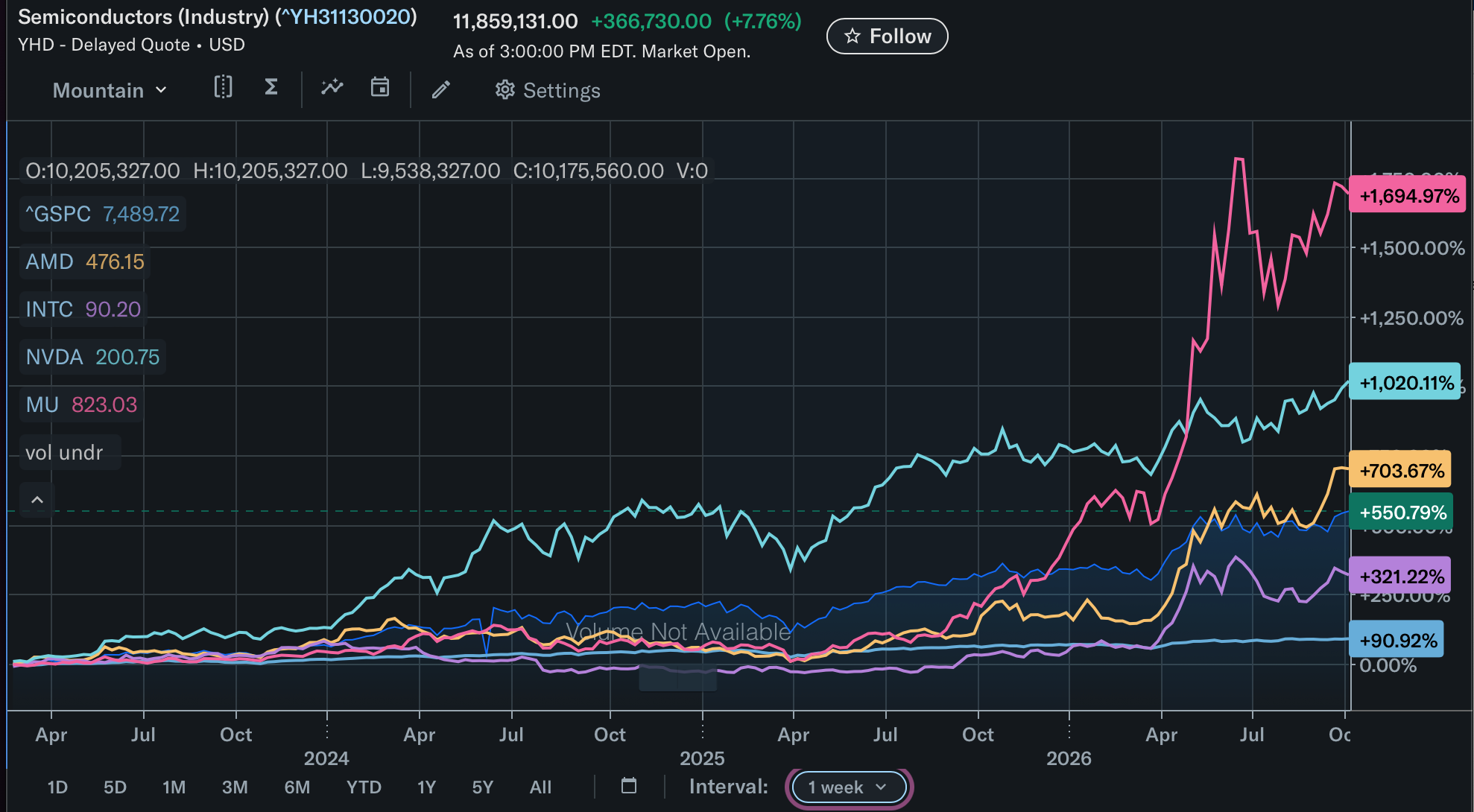
But the comparison investors are making isn’t simply between one chip stock and another. They’re increasingly comparing semiconductor valuations and earnings expectations with the broader market and then asking whether AI spending can continue at today’s extraordinary pace.
“The valuations imply that some companies are going to have much better outcomes than others,” said Gil Luria, managing director at D.A. Davidson & Co.”To me, that’s a big disconnect in the market.”
Luria says that Nvidia will continue to capture the largest share of profit due to their product just being better quality than their competitors. While they may not maintain their high market share forever, they will still be at the center of the buildout.
If a competitor in the semiconductor space wants to truly compete with Nvidia, they have to shift focus from chips to memory. For investors looking beyond Nvidia, memory has emerged as one of the most important pieces of the AI trade.
AI accelerators need massive amounts of high-speed memory to process increasingly complex models. The market is betting that this cycle will be different from the traditional boom-and-bust pattern of the memory industry.
Analysts say that the bullish case is that AI demand will remain strong enough to absorb new capacity as it comes online, allowing memory companies to maintain pricing power and profit margins.
When combined, the stocks like Samsung, SK Hynix and Micron actually have even more profits than Nvidia because memory is so important to the AI value change.
But that’s also where the risk comes in. Memory manufacturers eventually respond to high prices by adding capacity. If supply catches up faster than expected or if spending slows down, the economics could change quickly.
That risk is also concerning retail investors, who have a lot more to lose if the “AI bubble” pops. Individual investors like Matthew Low, grew more concerned after former employees at AI companies came forward and claimed the technology was too dangerous to be released, subsequently leading Open AI CEO Sam Altman to postponing the company’s highly anticipated IPO.
“I’m definitely concerned since the market is so heavily invested in AI stocks,” says Low. “Beyond the money I put in myself, just taking a look at how much of the market share AI has taken over so quickly, it definitely makes me more hesitant.”
Despite his concerns, when asked if he plans to sell, Low said he was still waiting.
“I’m just a regular guy and I put in regular guy money,” he said.
But the demand for AI traffic does not seem to be slowing down, despite news stories making investors skittish.
“It’s more about what valuation do you put on the earnings multiple or what valuation do you put on the stock, given all the countervailing confluence of stories that are out there,” said Cody Acree, senior Semiconductor research analyst at Benchmark/StoneX.
“There is an entire adoption curve that’s in front of AI that means this demand for compute and memory and connectivity is likely to be persistent for the next several years,” said Acree.
AI adoption is on the rise. Now only a few years into the AI revolution, investors in the Semiconductor space need to maintain confidence in the hardware, as the data centers and technology continue to develop.
If the AI companies are the prospectors who got rich off the California gold rush, then the semiconductor industry are the people who made money off of selling supplies like pickaxes to the miners, says Kim Forrest, Chief Investment Officer at Bokeh Capital Partners LLC.
“It’s going to be tough for institutional investors to keep up with this information,” said Forrest. “But I believe that this is an area of wealth creation for both the people who are creating the chips and the people who are investing in these new companies.”
But while the AI boom could be considered the digital “gold rush” it opens up the question of whether the gold will dry up and what will happen to those companies providing the digital supplies.